2026 Top Non Standard Bearing Types for Global Buyers?
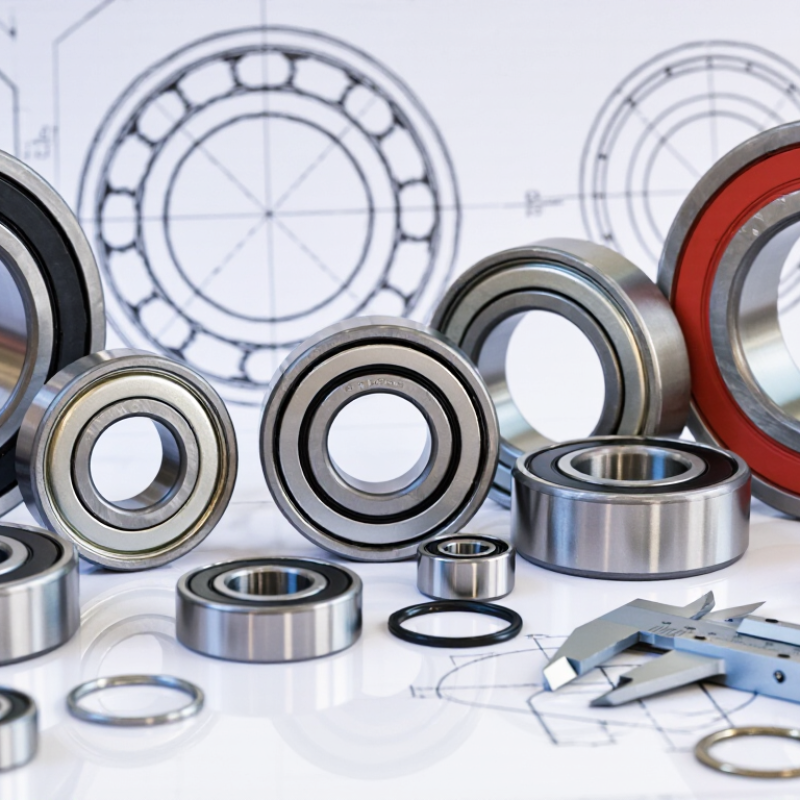
For global buyers, choosing a Non Standard Bearing starts with the application, not a catalogue label. These bearings are designed around dimensions, loads, speeds, or operating conditions that standard products may not meet. A compact flanged unit, for example, can simplify mounting where space is tight. A thin-section design may help reduce weight, while a custom housing or seal can address contamination concerns. The right choice depends on the full operating picture.
Common options include custom-dimension deep-groove ball bearings, thin-section bearings, flanged bearings, and special-material designs. Each has limits. Buyers should check radial and axial loads, rotation speed, temperature, lubrication, and expected service life. A drawing can clarify shaft and housing fits, seal positions, and tolerance requirements. Small details matter. A few tenths of a millimeter can affect installation or performance. The label can mislead.
Reliable sourcing also requires more than a competitive quote. Ask suppliers to confirm materials, manufacturing tolerances, inspection steps, and applicable test records. Compare lead times and minimum order quantities, especially for prototypes or low-volume production. If a bearing operates in a washdown area, dusty workshop, or high-temperature assembly, describe those conditions clearly. Suppliers cannot assess what they have not been told. Even with careful specifications, early samples may reveal an overlooked fit or noise issue. That is worth planning for. This guide examines key non-standard bearing types and practical selection points, helping buyers ask better questions before approving a design.
What Defines a Non-Standard Bearing? ISO 281 Rates L10 Life at 90% Reliability
2026 Top Non Standard Bearing Types for Global Buyers?
What Defines a Non-Standard Bearing? ISO 281 Rates L10 Life at 90% Reliability
A non-standard bearing is designed for requirements that a catalog bearing cannot readily meet. It may have unusual dimensions, a special internal clearance, or a customized seal arrangement. Non-standard does not mean untested. The design still needs clear specifications and appropriate performance checks.
ISO 281 defines basic rating life, L10, as the life that 90% of a sufficiently large group of identical bearings are expected to reach or exceed under stated conditions. It is a statistical estimate, not a promise for each bearing. The calculation uses factors including dynamic load rating and equivalent dynamic load. Life is commonly expressed in millions of revolutions.
Real conditions matter. A bearing in a dusty conveyor, for example, may experience shorter service life if contaminants enter the raceway or lubrication is inadequate. Misalignment and temperature can also change results. L10 does not capture every operating variable by itself. Modified life calculations may account for reliability levels and other influences, but their usefulness depends on reliable input data. A neat number can still mislead. Buyers should share load, speed, temperature, lubrication, and mounting details with the designer, then review assumptions before approving a custom bearing.
Main Types: Custom Radial, Thrust, Slewing, Linear, and Insert Bearings
2026 Top Non Standard Bearing Types for Global Buyers?
Custom radial bearings support loads perpendicular to the shaft and can be adapted for unusual dimensions, materials, or operating clearances.
Thrust bearings handle axial loads, such as pressure from a screw mechanism.
Slewing bearings support slow rotation in large assemblies, including platforms and positioning equipment.
Linear bearings guide straight-line movement along a shaft or rail.
Insert bearings fit into housings and can simplify replacement in common mounted arrangements.
Each type solves a different motion problem.
Tips: Share load direction, speed, temperature, space limits, and maintenance access with your supplier. A clear drawing helps. So do real operating measurements.
Do not choose by dimensions alone. A radial bearing that fits may still fail if the load changes direction or lubrication is poor. For slewing applications, check mounting flatness and bolt patterns; small errors can affect movement. Linear systems need suitable alignment and protection from dust. Insert bearings are convenient, but housing fit and shaft condition still matter. In practice, early specifications are often incomplete. That is worth reviewing before production, not after a noisy test run.
Design and Precision: ISO 492 Tolerance Classes P0, P6, P5, P4, and P2
ISO 492:2023 sets measurable tolerance limits for rolling-bearing dimensions and running accuracy. P0 is the standard class; P6, P5, P4, and P2 indicate progressively tighter tolerances. The exact limits depend on bearing type and size, so a class label alone is not a complete specification. Check the relevant ISO 492 table against the shaft, housing, and operating conditions.
Small differences matter. For a non-standard bearing, tighter precision can help control runout in a high-speed spindle, where a dial indicator tracks movement at the shaft. But specifying P2 by habit may raise cost without improving the assembly. ISO 281:2007 provides the basic rating-life calculation using dynamic load rating and equivalent load; it does not make precision class a substitute for correct load and fit calculations.
For purchasing, state the required class, bearing dimensions, load, speed, and fit conditions on the drawing. ISO’s tolerance tables provide the reference values, while measured inspection results help verify a delivered part. One detail is easy to miss: tolerance class does not, by itself, guarantee quieter operation or longer life. I would still review the application before upgrading a class.
Application Matching: Compare Loads, Speed, Temperature, and Lubrication
A non-standard bearing should be matched to the machine’s real operating conditions, not just its drawing. Start with radial and axial loads, including brief shock loads during startup or tool changes. A bearing that handles steady pressure may fail early when a conveyor repeatedly jolts under uneven material. Measure twice.
Speed changes the choice too. High rotational speed can increase heat and affect lubricant life, while slow, heavily loaded movement may need a different internal design. Check the actual duty cycle: a shaft running intermittently for ten minutes behaves differently from one turning continuously through a full shift. Published speed limits are useful, but they do not replace checks for fit, alignment, and load.
Temperature and lubrication must be considered together. Near a hot furnace, ask how the bearing, seals, and lubricant perform at the measured operating temperature—not just the surrounding air temperature. In a dusty workshop, grease retention and contamination control may matter more than a top speed figure. Heat changes things. Record temperatures after the machine reaches steady operation, and note how often relubrication is practical. One detail is easy to miss: maintenance access. A technically suitable bearing can still be a poor match if workers cannot inspect or lubricate it reliably. It is worth rechecking assumptions against actual service data; early estimates are often imperfect.
Buyer Verification: Check Drawings, Tolerances, Materials, and ISO 281 Ratings
2026 Top Non Standard Bearing Types for Global Buyers?
Buyer Verification: Check Drawings, Tolerances, Materials, and ISO 281 Ratings
A custom bearing can look correct on a screen and still fail to fit its housing. Verify the drawing revision, units, datum references, shoulder dimensions, chamfers, and fit requirements before production. Ask for a marked-up drawing and a first-article inspection report. Small details matter. ISO 492 defines bearing tolerance classes; compare measured bore, outside diameter, and runout against the specified class, not a supplier’s general “precision” claim.
Check material grade, heat-treatment records, and batch traceability. For a non-standard ring, request hardness results and dimensional readings tied to the same production lot. Review how measurements were taken, too. A number without a gauge method or calibration record is weak evidence. This check is easy to rush, and I would not treat a certificate as proof that every part matches.
For load-life comparisons, ISO 281:2007 calculates basic rating life as L10 = (C/P)^p million revolutions. Here, C is the dynamic load rating, P the equivalent dynamic load, and p is 3 for ball bearings or 10/3 for roller bearings. ISO 281 associates L10 with 90% reliability under its stated conditions; it is not a guaranteed service life. Ask suppliers to show the inputs, operating assumptions, and any reliability adjustment. A rating alone is not enough.
