
Finding the right MBBR supplier in China depends on more than price or a polished product catalogue. A Mbbr System For Wastewater Treatment uses moving biofilm carriers, aeration, and screening to support biological treatment in a compact tank. Its performance still depends on the wastewater, operating conditions, and system design. There is no single “best” unit for every plant.
A useful comparison starts with practical details. Ask how the carrier fill ratio was selected, how screens prevent media loss, and whether the aeration grid can be inspected without major downtime. Request design assumptions for flow, organic load, ammonia levels, and water temperature. These figures shape sizing and expected treatment results. A supplier should explain them clearly, not just promise high efficiency. That distinction matters.
Look for installation records, material specifications, operating guidance, and references from facilities treating similar wastewater. Check blower energy, access for maintenance, and the availability of replacement parts. If possible, compare performance data from a pilot or a site visit. A brochure cannot show every operating problem. Even a well-designed system may need adjustment after startup, and that deserves honest discussion. This guide examines how to assess Chinese MBBR manufacturers, compare technical proposals, and identify questions to ask before choosing equipment. The aim is a sound fit for your site—not a perfect-sounding promise.
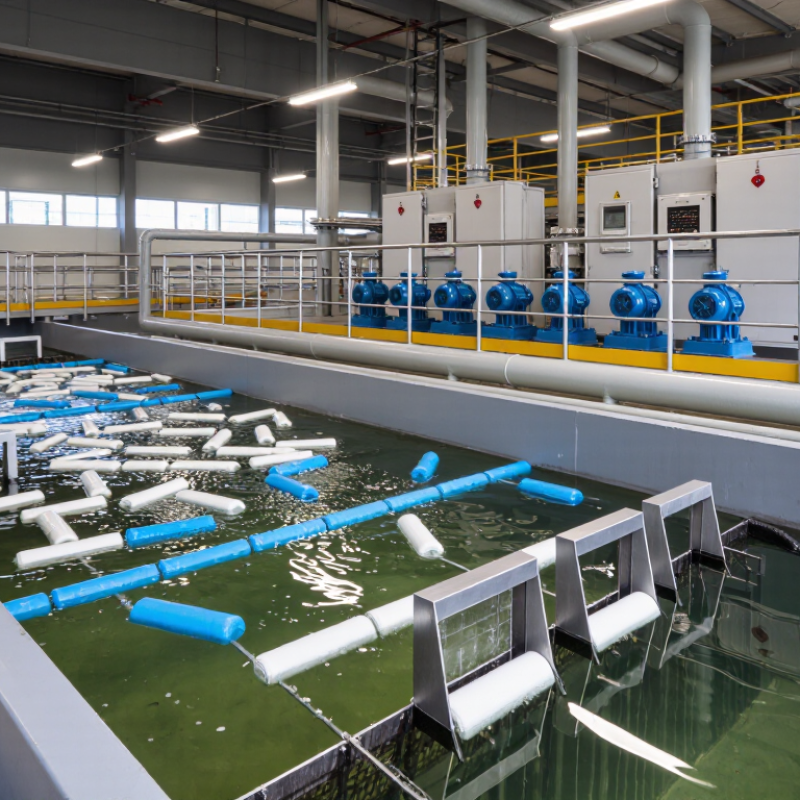
An MBBR, or moving bed biofilm reactor, treats wastewater using microorganisms that grow on small plastic carriers. These carriers move freely inside a tank, held in place by outlet screens. In aerobic systems, diffused air provides oxygen and keeps the media circulating. The biofilm on each carrier breaks down organic pollutants as wastewater passes through. Some systems also use suspended microorganisms, so treatment does not depend on the attached growth alone. Simple idea. Careful design.
An MBBR may be used for municipal sewage or industrial wastewater, often as one step in a larger treatment train. A downstream settling tank can separate solids before the treated water moves on. Performance depends on details such as carrier fill, airflow, temperature, incoming pollutant load, and tank mixing. Operators can check whether media is moving evenly and whether screens are accumulating debris. A quiet corner of the tank may signal poor circulation. It is not a plug-and-play fix. A design that works well on paper can still need adjustment when wastewater quality changes, and routine inspection remains important.
Moving Bed Biofilm Reactor (MBBR) systems use plastic carriers that provide surfaces for biofilm growth. A carrier fill ratio of about 30–70% of reactor volume is a common design range; the appropriate value depends on the treatment goals, reactor design, and carrier type.
An MBBR system uses small plastic carriers to provide a surface for helpful microorganisms. Wastewater usually passes through screening and, when needed, an equalization tank before entering the bioreactor. Inside, air bubbles or mechanical mixers keep the carriers moving. A thin biofilm grows on their surfaces and breaks down organic pollutants. It’s a busy tank. Downstream, a clarifier separates suspended solids, including biofilm that has naturally detached. Carrier-retaining screens keep the media inside the reactor.
In practice, the process is not simply “add carriers and wait.” The carrier fill ratio, oxygen supply, and mixing pattern affect treatment performance. For nitrogen removal, the design may include separate aerobic and anoxic zones. Operators should track dissolved oxygen and routine water-quality results, then adjust settings based on actual conditions. One point deserves reflection: a stable-looking tank does not always mean the effluent meets its target. Performance depends on testing, maintenance, and a design matched to the wastewater.
An MBBR system is more than a tank filled with plastic carriers. The treatment vessel holds wastewater and provides space for carriers to move freely. These small, buoyant pieces offer surface area for biofilm, the layer of microorganisms that helps break down pollutants. Carrier shape, fill fraction, and water movement affect how well the media works. Screens at the tank outlet keep carriers inside while allowing treated water to pass through. Easy to overlook.
Blowers and diffusers supply air in aerobic zones, keeping carriers in motion and supporting oxygen-dependent treatment. Anoxic zones may use mechanical mixers instead, depending on the treatment goals. Inlet pipes or distribution channels help spread incoming wastewater across the tank, while pumps manage flow between treatment stages. Controls and sensors can track flow, dissolved oxygen, and other operating conditions. A practical design also considers access for cleaning screens and inspecting equipment. Even a carefully drawn layout can miss uneven flow or difficult maintenance access. Check those details against site conditions before settling on component sizes.
China Best MBBR System for Wastewater Treatment?
Where Are MBBR Systems Used in China?
In China, moving bed biofilm reactor (MBBR) systems are used in municipal wastewater plants, especially for capacity upgrades where land is limited. The China Urban Construction Statistical Yearbook 2022 reports that urban plants treated about 63.1 billion cubic metres of wastewater that year. This figure shows the scale of treatment demand, not MBBR’s share of the market. In an MBBR tank, plastic carriers provide a surface for biofilm growth, helping increase biological treatment capacity without expanding the entire plant. Space is tight.
MBBR systems also serve county towns, residential developments, and industrial parks. Food-processing wastewater may suit biological treatment, while textile or chemical effluent usually needs careful pretreatment and process testing. Operators must check aeration, carrier-retention screens, and sludge handling; neglecting these can weaken performance. The technology is not a universal fix. It removes biodegradable pollutants, but it cannot reliably address every difficult contaminant on its own. China’s Ministry of Housing and Urban-Rural Development publishes annual urban infrastructure statistics, but public reports do not provide a comprehensive national count of MBBR installations. That gap matters when comparing project claims. A site-specific pilot is often more useful than assuming one design fits every plant.
| Application area | Where MBBR is used | Typical treatment role | Key design considerations |
|---|---|---|---|
| Municipal wastewater | Municipal wastewater treatment plants, including plants that need additional biological-treatment capacity. | Carbon removal and, when configured for it, nitrification or denitrification as part of a treatment train. | Influent characteristics, temperature, oxygen transfer, carrier retention screens, and the required discharge standard. |
| Industrial parks | Centralized wastewater facilities serving multiple factories in an industrial park. | Biological treatment after suitable pretreatment and equalization, depending on the wastewater mix. | Variable flows and loads, inhibitory or toxic compounds, salinity, pH, and the need for reliable upstream pretreatment. |
| Food and beverage processing | Facilities such as food-processing, beverage, and fermentation plants, where wastewater is suitable for biological treatment. | Biological reduction of biodegradable organic matter; nutrient removal may require additional process zones. | High or fluctuating organic loads, fats and suspended solids, cleaning-chemical inputs, and load equalization. |
| Textile and dyeing wastewater | Textile and dyeing facilities, generally as one biological stage within a broader treatment process. | Biological treatment of the biodegradable fraction after appropriate chemical or physical pretreatment where needed. | Dyes, salinity, toxicity, color, and the wastewater’s biodegradability; MBBR alone should not be assumed to remove all color or refractory compounds. |
| Pharmaceutical and chemical wastewater | Selected pharmaceutical and chemical production sites, where wastewater is shown to be biologically treatable. | A biological treatment step, often following source control, equalization, and process-specific pretreatment. | Toxicity, variable composition, low biodegradability, and the need for treatability testing before process selection. |
| Rural and decentralized wastewater | Small community or decentralized treatment facilities where a compact biological process is appropriate. | Biological treatment in a compact plant, with downstream solids separation or polishing as required. | Seasonal flow variation, low-load periods, operator availability, power supply, and management of screenings and sludge. |
| Existing plant upgrades | Existing biological-treatment tanks where additional attached-growth capacity may be feasible. | Adding biofilm surface area within a suitable tank while retaining or modifying the existing process configuration. | Tank hydraulics, aeration capacity, carrier-retention screens, mixing, downstream clarification, and compatibility with existing equipment. |
MBBR suitability depends on wastewater composition, treatability, process design, and the applicable discharge requirements. A pilot or laboratory assessment may be needed for complex industrial wastewater.
Evaluating an MBBR system in China starts with your wastewater, not a catalogue. Ask suppliers to state the design flow, peak flow, influent BOD, COD, ammonia, temperature, and required effluent limits. These figures shape reactor volume, carrier fill, aeration, and screening. Request calculations with assumptions visible, including seasonal loads and likely future expansion. Vague claims of high removal are not enough. Ask for comparable operating references and test data, then check whether the feedwater and operating conditions match yours. Check the screens.
Inspect the details that affect daily operation. Can the retaining screens handle the carrier size without clogging? Is air distributed evenly across the tank? Ask how the supplier manages dissolved oxygen, biofilm sloughing, and media loss, and what operators should inspect each shift. Request a process drawing, equipment list, commissioning plan, and clear warranty boundaries. Clarify spare-part lead times and who supports troubleshooting after installation. A polished proposal can still hide a weak assumption. Compare the same design basis across bids; otherwise, lower prices may reflect smaller capacity or omitted equipment. Projected energy use should include blowers, not just the biological process. No checklist is perfect; site conditions can still expose gaps. A site visit or video walk-through may reveal practical workmanship that documents cannot.