
2026 Best Vacuum Pump Oil for HVAC and Industrial Use?
Choosing the 2026 best vacuum pump oil requires more than comparing bottle prices. HVAC technicians face moisture, refrigerant exposure, heat, and repeated evacuation cycles. Industrial users add demanding factors, including long operating hours, fine contamination, and strict process stability.
Industry reports show why this decision matters. Grand View Research projects continued growth in the global vacuum pump market through 2030, driven by semiconductor, chemical, pharmaceutical, and refrigeration applications. The U.S. Department of Energy also emphasizes that properly maintained compressed-air and vacuum equipment can reduce avoidable energy losses. ASHRAE guidance highlights clean systems, correct service procedures, and suitable lubricants as practical foundations for reliable HVAC operation.
John F. O’Hanlon, author of A User’s Guide to Vacuum Technology, offers a useful warning: “A vacuum system is only as good as its weakest component.” That principle applies directly to vacuum pump oil. A pump may look healthy while darkened oil, dissolved refrigerant, or trapped moisture quietly reduces performance. Small details matter.
The right oil should match the pump design, operating temperature, vapor load, and manufacturer’s specifications. Mineral oils remain practical for many HVAC tasks. Synthetic fluids can offer stronger oxidation resistance and broader temperature performance, but they are not automatically better.
There is no universal winner.
This guide compares viscosity, vapor pressure, chemical stability, contamination tolerance, and real service experience. Some conclusions may remain imperfect because field conditions vary. That uncertainty deserves attention, not concealment.
What Is Vacuum Pump Oil and Why Does It Matter in HVAC and Industry?
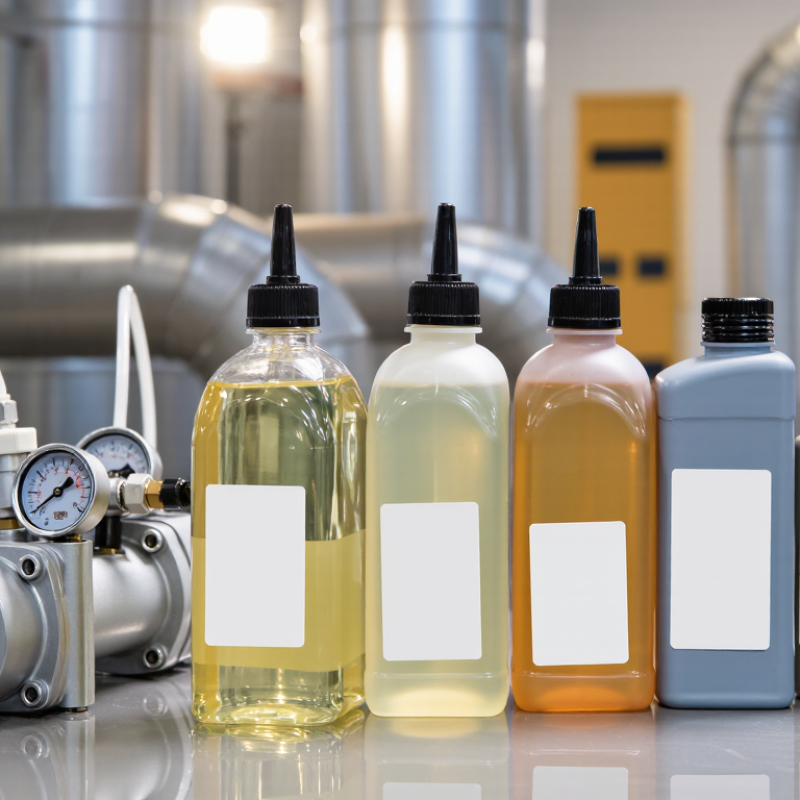
Vacuum pump oil is not a minor maintenance fluid. It forms the sealing film that helps a pump reach deep vacuum, controls heat, and carries moisture away from internal surfaces. In HVAC service, contaminated oil can raise the final micron level, increase running temperature, and extend evacuation time. The pump may sound normal. That is the risk.
ASHRAE Handbook—Refrigeration (2022) identifies 500 microns as a common evacuation target for refrigeration systems. Reaching that level depends on more than pump capacity. Oil viscosity, vapor pressure, cleanliness, and moisture resistance all affect performance. The U.S. Environmental Protection Agency also specifies evacuation requirements under Section 608, with targets that can reach 500 microns for certain equipment. A technician should verify vacuum with a calibrated micron gauge, not a compound gauge.
Industrial systems create harder conditions. Cutting fluids, dust, process vapor, and long operating cycles can quickly degrade oil. ISO 4406 provides a recognized method for classifying fluid contamination, although it was developed mainly for hydraulic applications. Its broader lesson still matters: contamination must be measured and controlled. Change oil when it becomes cloudy, dark, or chemically sharp-smelling. Do it earlier after a wet pull-down. Sometimes, the schedule is wrong.
A lower-cost oil may appear efficient, but higher vapor pressure can limit deep-vacuum performance. Synthetic formulations may offer better thermal stability, yet compatibility still requires checking the pump manual and operating temperature. Oil selection is not universal. It is a field decision, and field decisions deserve records.
2026 Best Vacuum Pump Oil for HVAC and Industrial Use? — What Is Vacuum Pump Oil and Why Does It Matter in HVAC and Industry?
A practical comparison of common vacuum-pump oil types for rotary-vane HVAC service and industrial vacuum applications.
| Vacuum Pump Oil Type | Typical Base Fluid | Common ISO Viscosity Grades | Typical Operating Temperature Range* | Key Performance Characteristics | Best-Fit Applications | Main Limitations | Selection Guidance |
|---|---|---|---|---|---|---|---|
| Refined Mineral Oil | Highly refined petroleum base oil | ISO VG 32, 46, 68, 100 | Approximately 10–70°C oil temperature, depending on pump design and cooling | Good lubrication, widely available, economical, and suitable for many standard rotary-vane pumps | Routine HVAC evacuation, refrigeration servicing, and general-purpose industrial vacuum work | More oxidation and vapor-pressure sensitivity than many synthetic alternatives; performance can decline faster under heat, moisture, or chemical contamination | Use the viscosity and specification stated by the pump manufacturer. ISO VG 68 is commonly selected for many general rotary-vane pumps, but it is not universal |
| Synthetic Hydrocarbon Oil | PAO or other synthetic hydrocarbon base fluid | ISO VG 32, 46, 68, 100 | Approximately -20–100°C, subject to formulation and pump limits | Low-temperature fluidity, improved oxidation resistance, and more stable performance over extended operating periods | Frequent HVAC service, demanding industrial duty, and equipment exposed to wider temperature changes | Higher purchase cost; seal, elastomer, or additive compatibility must be verified before changing from mineral oil | Useful when cold starts, long duty cycles, or elevated operating temperatures make conventional oil unsuitable |
| Synthetic Ester Oil | Diester or polyol ester base fluid | ISO VG 32, 46, 68 | Approximately -20–90°C, depending on formulation | Good lubricity and high-temperature performance; can provide strong film strength in demanding service | Selected industrial pumps and applications requiring specialized lubrication performance | Can be hygroscopic, meaning it may absorb moisture; moisture control and material compatibility are important | Choose only when the pump or oil supplier confirms compatibility with seals, coatings, and residual oil in the system |
| Low-Vapor-Pressure Synthetic Oil | Specially refined synthetic hydrocarbon or other low-volatility formulation | Commonly ISO VG 46 or 68 | Approximately 15–90°C, depending on product formulation | Reduced oil backstreaming and improved cleanliness at low absolute pressures | Processes where hydrocarbon vapor contamination must be minimized | Usually costs more and may not be compatible with every pump, seal material, or existing oil charge | Consider it for clean vacuum processes, analytical work, or applications with strict contamination limits |
| PFPE Vacuum Fluid | Perfluoropolyether | Viscosity varies widely by formulation; follow the equipment specification | Often suitable for high-temperature or chemically aggressive service, within the stated product limits | Excellent chemical inertness, nonflammability, and strong resistance to oxidation and aggressive chemicals | Specialty industrial, oxygen-enriched, semiconductor, chemical, and highly reactive environments | Very high cost; limited lubricating compatibility with conventional oils and many pump designs | Use only when the pump is specifically approved for PFPE fluid and the process hazards justify the cost |
| High-Vacuum Diffusion-Pump Fluid | Specialized silicone or hydrocarbon fluid, depending on the system | Not normally classified by standard rotary-pump ISO VG selection | Designed for elevated heater and vaporization temperatures specified by the diffusion-pump manufacturer | Low vapor pressure and controlled vaporization for diffusion-pump operation | Diffusion-pump systems rather than standard HVAC rotary-vane pumps | Not a general substitute for rotary-vane pump oil; incorrect fluid can damage performance or create unsafe operating conditions | Do not use in an HVAC service pump unless the manufacturer explicitly specifies the fluid |
Important: The best vacuum pump oil is determined by pump design, required ultimate pressure, operating temperature, refrigerant or process chemistry, moisture load, seal compatibility, and the manufacturer’s approved specification. Replace oil when it becomes cloudy, dark, contaminated, or chemically degraded, and change it after heavily contaminated evacuation work. Temperature ranges and viscosity grades shown above are representative guidance, not universal limits.
Related Posts
-

2026 Top Vacuum Pump Oil Types for Global Buyers
-
Top 10 Vacuum Pump Oils: Choosing the Best for Optimal Performance
-

How to Choose the Right AC Pump for Your Needs?
-
Top Factors to Consider When Choosing a High Vacuum Pump for Your Needs
-

What is an Oil Less Vacuum Pump and How Does It Work?
-

2026 Top Oil Vacuum Solutions for Global Buyers Need?